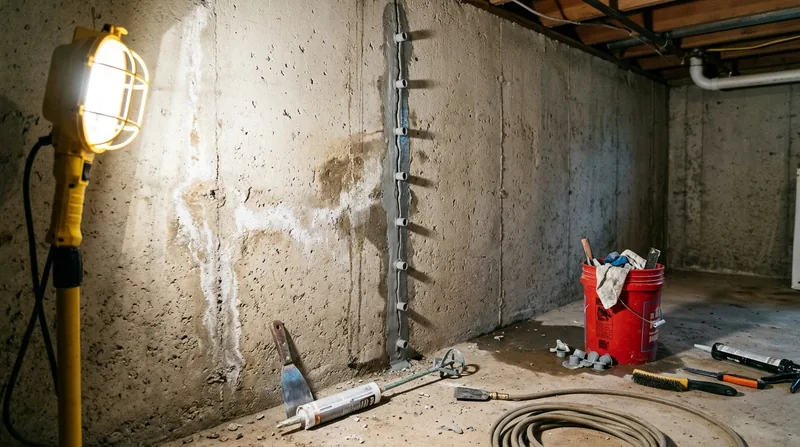




Waterbury sits in a valley of glacial till over schist and gneiss, and that geology decides where foundation cracks show up. On the hillsides of Town Plot, Bunker Hill and Brooklyn, the 1890s to 1930s workers' houses and brick two-families sit on full basements with stone, brick or early block walls. Those walls were never designed for the runoff that comes down the hillside streets in a heavy spring rain. Foundation crack repair in Waterbury starts with reading the crack, not with a tube of sealer. A hairline in a poured wall is a different animal from a stair-step crack in a brick wall that has been worked by sixty freeze-thaw winters. We inspect the crack, identify whether it is shrinkage, settling or hydrostatic pressure, and match the repair to the cause. If you are also dealing with water on the floor, start with our basement waterproofing service and we will sort out which problem is driving the other.
Why Foundation Cracks Open in Waterbury's Older Hillside Neighborhoods
The building stock here tells the story. Stone and brick foundations in Town Plot and Brooklyn were laid without modern drainage, and the old clay footing drains under them have long since collapsed or silted shut. When the seasonal water table climbs in the Naugatuck River bottoms and the Mad River floodplain, water has nowhere to go but against the wall. Add the freeze-thaw cycle that works every crack a little wider each winter and you get the pattern we see on nearly every inspection.
- Settling cracks appear where a hillside lot has shifted under a stone or brick wall, often as a stair-step pattern.
- Shrinkage cracks show up in poured concrete walls of 1970s and later colonials on the ridges, usually vertical and narrow.
- Hydrostatic pressure pushes water through hairline cracks and forces efflorescence onto the interior face.
- Frost heave opens horizontal cracks near grade on older walls that were never backfilled with free-draining material.
Each of those cracks needs a different repair, and sealing the wrong one just moves the water to the next weak point.
Key info: A brick two-family on a Bunker Hill side street with a stair-step crack at the corner is a settling problem, not a sealer problem. We have seen homeowners in Waterbury pay twice for crack patches because nobody checked the wall below grade first.
For permit questions on structural repair, check with the City of Waterbury Building Department at waterburyct.org before work begins. Rules vary by jurisdiction and must be verified.
How We Repair Foundation Cracks in Waterbury, Step by Step
We do not sell one method to every homeowner. The first visit is a free basement inspection where we map the crack, check for bowing, test for moisture and look at how the wall meets the footing. From there we recommend epoxy injection, polyurethane injection, or a structural repair when the crack is wide enough that frost and settling have moved the wall. If the crack is only a symptom of pressure behind the wall, we say so and explain the interior drain tile option instead of injecting and walking away.
- We inspect the crack and the wall face, checking for bowing, efflorescence and moisture at the footing.
- We clean the crack and set injection ports at the right spacing for the width and depth of the break.
- We seal the surface, remove the ports and verify the repair holds under pressure before we leave.
- We recommend a follow-up if the crack sits in a wall showing signs of movement, and we explain what to watch for.
If the inspection turns up a wall that has moved, we will point you to our bowing wall repair service rather than inject a crack that needs carbon fiber straps or wall anchors.
Key info: A 1950s Cape Cod in Hopeville with a partial basement had a vertical crack leaking after every nor'easter. Polyurethane injection stopped the leak in one visit because the wall was stable. A similar crack in a 1920s brick wall on the Westside needed epoxy and a look at the footing drain, because the wall had movement behind it.
Matching the Repair to the Crack: Methods We Use
Not every crack gets the same treatment, and the table below shows how we decide. The choice depends on whether the crack is structural, active or cosmetic, and on what the wall is made of.
| Approach | Description | Best for |
|---|---|---|
| Epoxy injection | Structural bonding of the crack faces back together. | Stable poured walls with cracks that are not actively leaking. |
| Polyurethane injection | Flexible foam that fills the crack and stops active water. | Active leaks in poured or block walls, and cracks that move slightly. |
| Surface sealing and parging | Hydraulic cement or membrane over a cleaned wall face. | Cosmetic hairline cracks with no water and no movement. |
| Structural repair | Carbon fiber straps or wall anchors where the wall has bowed. | Wide cracks and horizontal cracks from frost and settling. |
| Drainage correction | Interior perimeter drain and sump to relieve hydrostatic pressure. | Cracks that keep leaking because water is trapped at the footing. |
The right method is the one that matches the cause, and we will tell you plainly when a simple seal is enough.
Foundation Crack Repair Cost in Waterbury: What to Expect
Most single-crack injections in Waterbury start at $450, and that figure covers the inspection, port setting, injection and cleanup for a straightforward vertical crack in a poured wall. The price climbs when the crack is wider, when the wall is brick or stone, when access is tight in a full basement, or when the inspection shows the crack is a symptom of pressure that needs drainage work. We publish a full breakdown on our pricing page so you can see how the numbers are built.
Get two or three estimates and compare what each one includes. A low number that covers only the injection and not the inspection is not the same job. Ask whether the contractor will check for bowing and efflorescence, and whether they will tell you if the real fix is drainage rather than sealer.
Foundation Crack Repair Near Me: How to Vet a Contractor Near Waterbury
When you search for foundation crack repair near me, the list you get is mostly whoever paid for the ad. Here is what actually matters when you are choosing someone to work on a 100-year-old wall in Waterbury or a poured wall in Naugatuck. Ask for proof of licensing and insurance, get more than one estimate, and call references from jobs in the same kind of housing stock.
- Confirm the contractor is licensed and insured, and ask for a certificate before work starts.
- Get two or three written estimates that spell out the method and what is included.
- Ask for references from older homes with stone, brick or block walls, not just new construction.
- Ask whether a permit is required for structural repair in your jurisdiction and who pulls it.
- Check for HOA rules if you live in one of the newer subdivisions on the ridges.
If a contractor will not put the method in writing, keep looking. You can reach us through our contact page to set up a free inspection.
Foundation Crack Repair in Waterbury: Pricing Guide
| Service | Price | Details |
|---|---|---|
| Single crack injection (poured wall) | Starting at $450 | Includes inspection, port setting, epoxy or polyurethane injection and cleanup for one vertical crack. |
| Multiple crack injection | Starting at $750 | Priced per crack after the first, with the total driven by crack count and wall access. |
| Brick or stone wall crack repair | On estimate | Older masonry needs an on-site look before a number is given because the repair method changes. |
| Structural repair (bowing or wide cracks) | On estimate | Carbon fiber straps or wall anchors require an on-site assessment of wall movement and footing condition. |
| Travel | Included | In Waterbury and surrounding areas, no separate call-out or mileage fee. |
| Estimate | Free | Response within 24h at (475) 263-4038, no obligation to book. |
Indicative pricing, the exact cost depends on square footage, finish, and site access. Free personalized estimate within 24h at (475) 263-4038.


