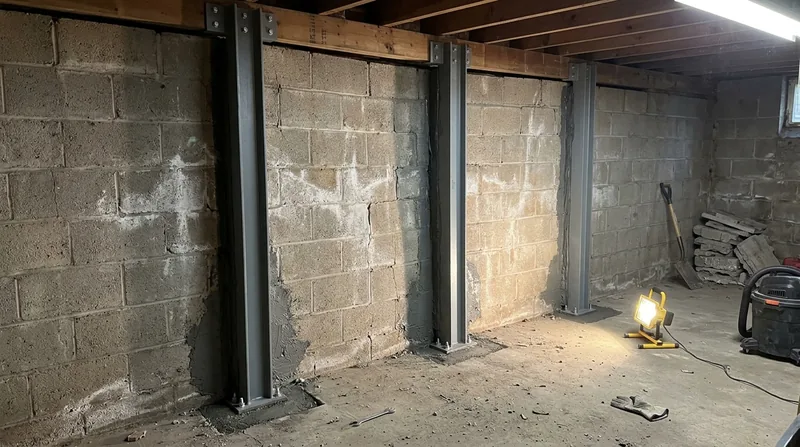




Bowing Wall Repair in Waterbury: When Hillside Soil Pushes Back
If you own one of the 1890s to 1930s brick two-families on the Town Plot or Bunker Hill slopes, or a 1950s Cape on the Westside, you already know that Waterbury ground moves. Glacial till over schist and gneiss, thin on the ridges and deep in the Naugatuck River bottoms, holds a seasonal water table that climbs hard every spring. When that saturated soil presses on an old stone, brick, or early block wall, the wall bows inward. Bowing Wall Repair in Waterbury is the work of stopping that movement before the wall displaces further, and we do it with carbon fiber straps, steel I-beams, or wall anchors matched to your soil and the severity of the lean. Call (475) 263-4038 for a free basement inspection. For walls that are also wet, start with our basement waterproofing page and we will sort out the structural side on site.
Why Bowing Walls Are Common in Waterbury's Older Hillside Homes
Most of Waterbury's bowing walls sit in the same handful of neighborhoods, and the cause is almost always the same: hydrostatic pressure from saturated hillside soil. The old clay footing drains under these houses have been silting up for decades, so spring runoff from the hillside streets has nowhere to go but against the wall. Freeze-thaw winters work the cracks open every year, and the 1955 Naugatuck River flood still marks the low lots in the valley.
- Stone and brick walls in Town Plot and Brooklyn were laid without modern reinforcement and lean under sustained lateral load.
- Early block walls in Hopeville and Pine Hill crack at the mortar joints and bow along the horizontal courses.
- Poured walls on the ridgeline colonials crack at the middle third when backfill compresses and the water table rises.
- Clay footing drains that no longer carry water send runoff straight into the soil behind the wall.
We read the wall before we quote anything, because a hairline crack and a two-inch bow are two different jobs.
Key info: A brick two-family on a Bunker Hill side street had a rear wall pushed in about 1.5 inches over ten years. The clay footing drain was plugged and the downspouts dumped at the foundation. We stabilized the wall with carbon fiber straps and corrected the drainage, and the wall has held.
Structural repair permits in Connecticut are handled locally, so verify the current requirement with the Connecticut Department of Consumer Protection and the Waterbury building department before work begins.
How We Diagnose and Stabilize a Bowing Wall in Waterbury
We start below grade, not at the top of the wall. The first visit maps the wall movement, checks the soil and drainage behind it, and confirms whether water is the driver or whether the wall is simply undersized for the load. From there we match the repair to the severity, because a strap on a wall that needs anchors is money wasted.
- We measure the bow with a plumb line and record crack widths and locations.
- We inspect the footing drain, downspout discharge, and grading on the uphill side.
- We recommend carbon fiber straps for minor to moderate movement, steel I-beams for heavier loads, or wall anchors where the soil is the main problem.
- We correct the water source with an interior drain tile system or exterior membrane so the repair is not fighting the same pressure next spring.
- We patch and seal the wall face and leave you with a written record of the movement for future reference.
Every repair ends with a drainage check, because a stabilized wall without water control is a temporary fix.
Key info: On a 1920s home in Oakville, the wall had bowed about an inch and the basement smelled musty after every rain. We installed wall anchors and tied them to an interior drain tile system, and the homeowner has not had standing water since.
Repair Methods We Use and When Each One Fits
There is no single fix for a bowing wall. The right method depends on how far the wall has moved, what the wall is made of, and how much water the soil is holding. Here is how we match the approach to the job.
| Approach | Description | Best for |
|---|---|---|
| Carbon fiber straps | Straps bonded to the interior wall face and anchored top and bottom to resist further inward movement. | Minor to moderate bowing in block or poured walls. |
| Steel I-beams | Vertical beams set against the wall and tied into the floor and joists to brace the wall. | Heavier loads and walls with significant displacement. |
| Wall anchors | Anchors driven into stable soil outside and connected through the wall to plates inside. | Walls pushed by saturated hillside soil, where the earth is the main force. |
| Drainage correction | Interior drain tile, footing drain repair, and downspout extensions to relieve hydrostatic pressure. | Any wall where water is driving the movement. |
We will tell you plainly when simple crack sealing is enough and when the real problem is pressure that needs a drainage fix alongside the structural repair.
Bowing Wall Repair Cost in Waterbury: What to Expect
Bowing wall repair is priced by the linear foot and by the method, so a single strap on a short wall and full anchor installation on a long stone wall are very different numbers. As a starting point, minor stabilization work begins around $600, and the figure climbs with wall length, access, and whether drainage has to be corrected at the same time. We give you the range after the inspection, not before.
The main cost drivers are the length and height of the wall, the repair method, how far the wall has moved, and whether the footing drain needs repair. Access matters too: a wall behind a finished basement or under a low deck takes more labor than an open wall. Getting two or three estimates is smart, and we are glad to explain what each one covers. See our full pricing overview for more detail.
Choosing a Bowing Wall Repair Contractor Near Me in Waterbury
Not every foundation contractor handles bowing walls, and not every waterproofing company does structural work. Ask what method they propose and why, and make sure the company is licensed and insured in Connecticut. Ask for references from Waterbury or Naugatuck jobs, and confirm who pulls the permit if one is required.
- Confirm the company carries liability insurance and workers compensation, and ask for a certificate.
- Get two or three written estimates that state the method, the linear footage, and the warranty terms.
- Ask whether the price includes drainage correction or treats it as a separate line item.
- Check references for jobs on the same wall type and soil conditions as yours.
- Verify permit requirements with the Waterbury building department before signing.
We are happy to walk you through our approach and put the scope in writing. Reach us through the contact page or call (475) 263-4038 to schedule a free basement inspection.
Bowing Wall Repair in Waterbury: Pricing Guide
| Service | Price | Details |
|---|---|---|
| Carbon fiber strap installation | Starting at $600 | Covers minor stabilization on a short wall section, with price rising by linear footage and wall height |
| Steel I-beam bracing | Starting at $1,200 | Includes beam set, floor and joist tie-in, and patching, with cost driven by wall length |
| Wall anchor system | On estimate | Requires on-site soil review and wall measurement before a number is given |
| Drainage correction add-on | On estimate | Interior drain tile or footing drain repair priced after inspection of the water source |
| Travel | Included | in Waterbury and surrounding areas, no separate call-out or mileage fee |
| Estimate | Free | Response within 24h at (475) 263-4038, no obligation to book |
Indicative pricing, the exact cost depends on square footage, finish, and site access. Free personalized estimate within 24h at (475) 263-4038.


