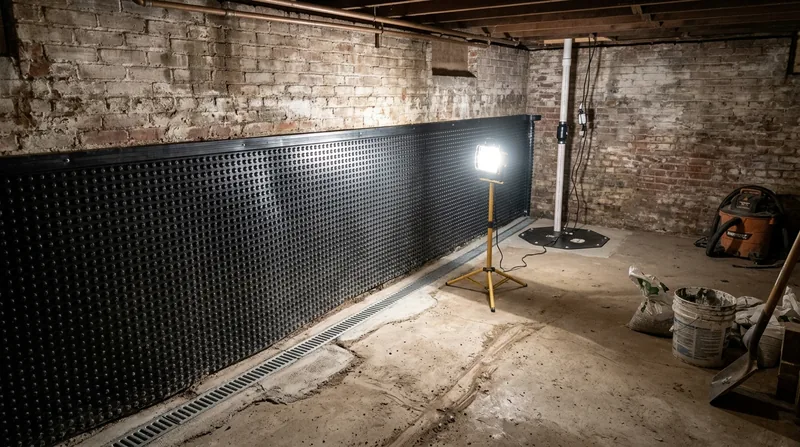




If you own one of the 1890s to 1930s workers' houses on the Town Plot hillside, you already know the pattern: heavy spring rain sheets down the street, finds the downhill wall, and shows up as a wet basement by morning. Basement Waterproofing in Waterbury starts with the ground, not the product. This city sits on glacial till over schist and gneiss, thin on the ridges and deep in the valley, and the seasonal water table climbs fast in the Naugatuck River bottoms and the Mad River floodplain. Stone, brick, and early block walls with old clay footing drains were never built for that load. We trace the real water path, hillside runoff, hydrostatic pressure, seepage through mortar joints, floor cracks, and then build the system that fits the house. Start with a free basement inspection before anyone quotes a fix.
Why Waterbury Basements Leak: Hillside Runoff, Valley Till, and Old Walls
The failure mode that dominates here is hydrostatic pressure against downhill walls after nor'easter rain, not a single hairline crack. On Bunker Hill and Brooklyn, runoff from the street above loads the uphill side of brick two-families while the downhill basement floor stays dry. In Hopeville and Pine Hill, the 1940s to 1960s Capes and splits with partial basements wick moisture through block joints and leave efflorescence on the wall. In the Naugatuck bottoms, the water table does the work, and the 1955 flood line is still a useful marker for which low lots need a sump system rather than crack sealing.
- Hillside streets push surface runoff against the downhill foundation wall within minutes of a heavy storm.
- Glacial clay soil in the valley holds water and feeds the seasonal water table all spring.
- Old clay footing drains in Town Plot and Bunker Hill are crushed or silted, so they stop carrying water away.
- Freeze-thaw winters work existing cracks open a little more every year.
- Stone and early block walls weep through mortar joints long before a crack is visible.
When several of these line up, sealing the wall face alone will not hold, and the answer is drainage plus pressure relief.
Key info: A 1920s brick two-family on a Town Plot side street had a dry uphill wall and a wet downhill floor for years. The culprit was the street crown shedding water onto the downhill footing, not a failing wall. A downspout extension and regrading cut most of the flow before we touched the basement.
Permits for structural foundation repair and work that alters drainage vary by jurisdiction, so confirm the current rules with the City of Waterbury building department before work begins.
How We Waterproof a Waterbury Basement: Trace the Water, Then Build the System
We start by finding where the water actually enters, because a crack on the wall is often a symptom and not the source. On a valley lot the source may be the water table; on a ridge lot it is usually hillside runoff and a failed footing drain. We map the wet pattern after rain, check the wall type (stone, brick, block, poured), and test whether the floor crack is active. Then we recommend the least invasive system that solves the real problem.
- We inspect the basement after a rain event and mark every wet line, crack, and floor joint.
- We check grading, downspout extension, and window well drainage on the uphill side.
- We probe the footing drain where accessible to see whether it still carries water.
- We recommend interior drain tile, exterior waterproofing, crack injection, or a combination based on pressure and wall condition.
- We install the system, test the sump pump and check valve, and confirm the discharge line runs clear.
If the wall is bowing, drainage alone is not enough, and we bring in bowing wall repair with carbon fiber straps or wall anchors before finishing the waterproofing.
Key info: A 1950s split-level in Hopeville had water on the floor only after nor'easters. The wall was sound, the footing drain was silted, and the water table rose into the slab. An interior drain tile system with a sump basin solved it without excavating the hillside.
Waterproofing Approaches We Use on Waterbury Homes
Not every wet basement needs the same system, and the right choice depends on wall type, water source, and how much of the basement you need dry. The table below shows how we match the approach to the house.
| Approach | Description | Best for |
|---|---|---|
| Interior drain tile | Perimeter drain cut into the floor slab, leading to a sump basin and pump. | Hydrostatic pressure and water table rise in valley lots and full basements. |
| Exterior waterproofing | Excavation to the footing, membrane and dimple board, new footing drain. | Failed original footing drain and wall damage on accessible sides. |
| Crack injection | Epoxy or polyurethane injection through ports into the crack. | Isolated poured-wall cracks with no broad pressure problem. |
| Wall sealing and vapor barrier | Parging, waterproof membrane, and dimple board or vapor barrier on the interior face. | Seepage through stone and block joints and musty basement smell. |
| Sump pump and battery backup | Sump basin, primary pump, check valve, discharge line, battery backup. | Any basement with a drain system, especially where power fails in storms. |
We size the system to the house, so a partial basement in Pine Hill does not get a full-perimeter quote it does not need.
Basement Waterproofing Cost in Waterbury: What to Expect
Most Waterbury homeowners want a number before they want a system, and that is fair. Pricing starts from $2,500 for targeted work such as crack injection or a focused wall sealing job, and rises with the scope. A full interior perimeter drain with a sump basin and pump on a 1,000 square foot basement typically runs well above that starting point, and exterior excavation on a steep ridge lot costs more again because of access and soil handling.
The factors that move the price most are the length of drain run, wall type (stone and brick take more labor than poured concrete), whether a new sump basin and discharge line are needed, and access for equipment on narrow hillside streets. Getting two or three estimates is smart because the diagnosis matters more than the price, and a quote that skips the water source will not fix the wet floor. See the full pricing overview for line-item detail before you compare bids.
Hiring a Basement Waterproofing Contractor Near Me in Waterbury
Waterbury has plenty of general contractors who will seal a wall, but basement water is a diagnostic trade, and the difference shows in the second storm. Ask any contractor near Waterbury three questions: what is the water source, what happens to the discharge, and what is the warranty. A dedicated waterproofing specialist will answer all three before quoting.
- Confirm the contractor is licensed and insured, and ask for a certificate of insurance before work starts.
- Get two or three written estimates that name the system and the water source, not just a price.
- Ask for references from Waterbury or Naugatuck homes with the same wall type and water problem.
- Ask who pulls any permit required for structural repair or drainage changes, and confirm it with the building department.
- Read the warranty terms and confirm they are transferable if you sell the house.
If a quote promises a lifetime warranty or skips the water source entirely, keep looking. You can request a free estimate and we will walk the basement with you before any number is discussed.
When Simple Crack Sealing Is Enough, and When It Is Not
Some wet basements are one crack and nothing more. A poured wall with a single vertical crack that seeps after rain, no efflorescence, and a dry floor is a good candidate for epoxy or polyurethane injection, and that is the honest, low-cost answer. The picture changes when water comes up through the floor joint, when the wall sweats across a wide area, or when the wet pattern follows the water table rather than the rain.
In those cases the pressure is coming from outside the wall, and injection alone will fail within a season or two. That is when interior drain tile, a sump pump, and wall treatment make more sense than repeated sealing. We tell homeowners plainly which case they are in, because a cheap fix that fails costs more than the right system the first time.
Seasonal Timing for Basement Waterproofing in Waterbury
The demand here follows the freeze-thaw cycle and the spring water table, not a coastal fog pattern. Late winter and early spring are when the ground thaws, the Naugatuck bottoms fill, and the calls come in for wet basements and sump pump failures. Summer and early fall are the practical window for exterior excavation and drain work, when the ground is workable and the water table is lower.
If your basement is wet now, do not wait for the dry season to diagnose it. The wet pattern is the best evidence we get, and a free inspection during a storm week tells us more than a dry-season walkthrough. Call (475) 263-4038 to schedule while the water is still showing you where it enters.
Basement Waterproofing in Waterbury: Pricing Guide
| Service | Price | Details |
|---|---|---|
| Crack injection (epoxy or polyurethane) | Starting at $2,500 | Covers injection ports, resin, and finishing on isolated poured-wall cracks with no broad pressure problem. |
| Interior drain tile with sump basin | From $4,500 | Perimeter drain, sump basin, primary pump, and check valve; price moves with drain run length and wall type. |
| Exterior basement waterproofing | From $8,000 | Excavation to footing, membrane, dimple board, and new footing drain; access on steep ridge lots raises the figure. |
| Sump pump replacement with battery backup | From $1,200 | New primary pump, battery backup unit, check valve, and discharge line tied to the existing basin. |
| Complex or large-scale job | On estimate | Stone or brick walls, bowing walls, or multiple water sources need an on-site look before a number is given. |
| Free basement inspection | Free | Response within 24h at (475) 263-4038, no obligation to book, water source identified before quoting. |
Indicative pricing, the exact cost depends on square footage, finish, and site access. Free personalized estimate within 24h at (475) 263-4038.


